
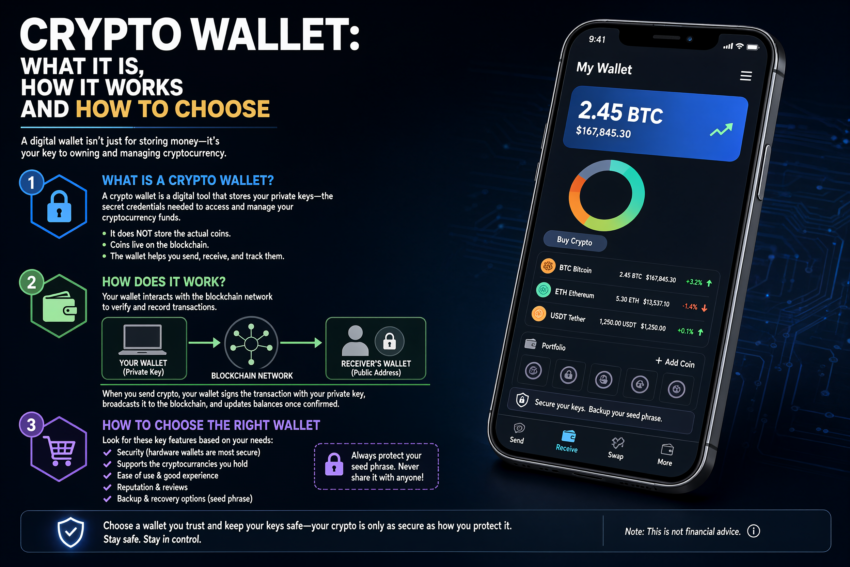
If you have ever tried to buy your first coin, you probably ran into the same question everyone does: where do I keep it? The answer is a crypto wallet. It sounds simple, but the choices can feel confusing fast. Hot wallet, cold wallet, custodial, non-custodial, seed phrase, private key. It is a lot of new words for something that should just be a safe place for your money.
This guide breaks it all down in plain language. You will learn what a crypto wallet really is, how it works behind the scenes, which type fits your needs, and how to keep your coins safe. No heavy jargon, no hype. Just the things a beginner actually needs to know, explained the way you would explain it to a friend.
What Is a Crypto Wallet?
A crypto wallet is a tool that lets you send, receive, and manage digital money like Bitcoin, Ethereum, and thousands of other coins. The name is a little misleading, though. Unlike a leather wallet, it does not actually hold your coins. Your coins live on the blockchain, which is a public record shared across thousands of computers. What the wallet holds is the proof that those coins belong to you.
Think of it like a mailbox with a special lock. Anyone can drop mail into the box if they know the address, but only you have the key to open it. In the same way, anyone can send crypto to your wallet address, but only you can move it out. That key is what matters most, and we will come back to it in a moment.
Today, a crypto wallet does a lot more than store coins. Many wallets let you swap one coin for another, earn rewards by staking, collect digital art, and connect to apps built on the blockchain. Popular wallets such as Trust Wallet and Bitget Wallet now bundle many of these features in one app, which is why a wallet has become the starting point for almost everything people do in crypto.
How a Crypto Wallet Really Works
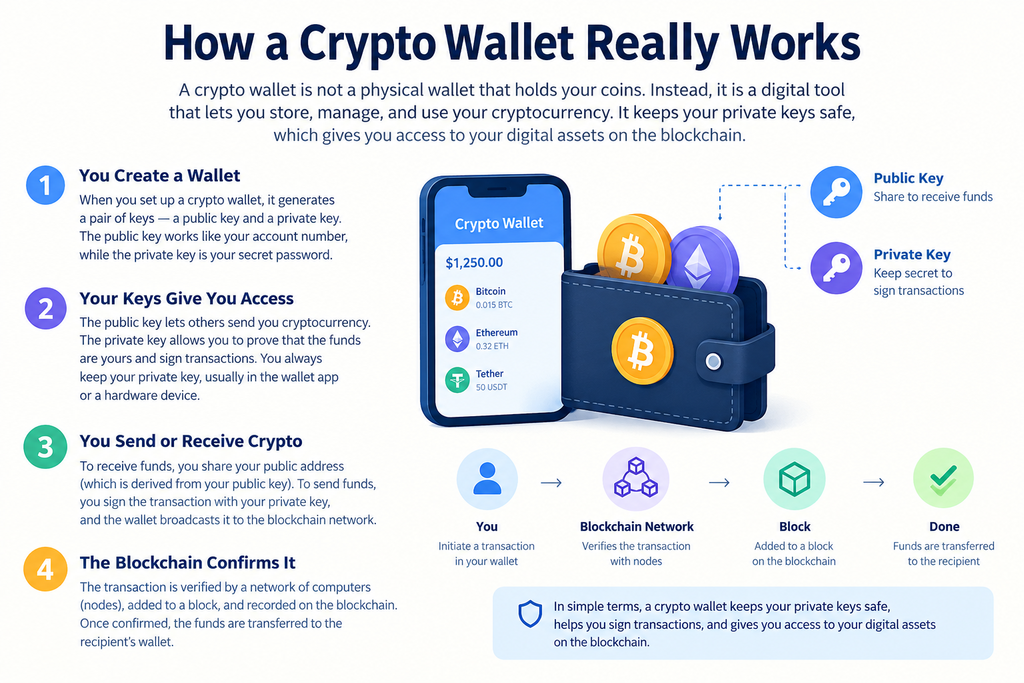
Every crypto wallet is built around two pieces of information: a public key and a private key. The public key is the part you share. It creates your wallet address, which is a long string of letters and numbers. You can give this address to anyone who wants to send you crypto, much like sharing your email address.
The private key is the secret part. It is like the password and the signature rolled into one. When you want to send crypto, your wallet uses the private key to approve the transaction. Without it, nothing can move. And if someone else gets hold of it, they can take everything, with no bank to call and no way to reverse it.
Because private keys are long and hard to remember, most wallets give you a recovery phrase instead. This is a list of 12 or 24 simple words, sometimes called a seed phrase. It works as a master backup. If you lose your phone or your computer breaks, you can type these words into a new wallet and get your coins back. That is also why you must never share it with anyone. Anyone who has your recovery phrase has your money.
When you send crypto, your wallet creates a message that says how much you are sending and where it should go, then signs it with your private key. The message is sent to the network, checked by computers called nodes, and added to the blockchain. This usually takes a few seconds to a few minutes, depending on the coin and how busy the network is. You also pay a small fee, often called a gas or network fee, to cover the cost of processing.
Hot Wallets and Cold Wallets
The first big choice is between a hot wallet and a cold wallet. The difference is simple. A hot wallet is connected to the internet, while a cold wallet is not.
Hot wallets are apps or browser add-ons that live on your phone or computer. They are quick to set up, free to use, and perfect for everyday actions like buying, swapping, or trying out a new app. Because they are always online, they are very convenient. The trade-off is that being online also makes them easier to attack. If your phone picks up a virus or you click on a fake link, a hot wallet can be at risk.
Cold wallets keep your private keys offline, usually on a small physical device that looks like a USB stick. These are often called hardware wallets. To approve a transaction, you plug the device in or connect it by Bluetooth, confirm on the device itself, and the keys never touch the internet. That makes them much harder to hack. The downsides are the cost, since you have to buy the device, and a little less convenience when you want to make quick moves.
Most experienced users end up using both. They keep a small amount in a hot wallet for daily use, like the cash in your pocket, and store the larger savings in a cold wallet, like a safe at home. If you are only starting with a small amount, a trusted hot wallet is a perfectly good place to begin. You can always move to a hardware wallet later as your holdings grow.
Custodial vs Non-Custodial Wallets
There is another difference that matters just as much, and it is about who controls your private keys. In a custodial wallet, a company holds the keys for you. This is what happens when you leave your coins on an exchange. You log in with a username and password, and the company takes care of the rest. It feels familiar, like online banking, and if you forget your password you can usually reset it.
The catch is that you are trusting the company completely. If the platform gets hacked, freezes withdrawals, or shuts down, your coins can be stuck or lost. You may have heard the saying “not your keys, not your coins.” This is exactly what it means. If you do not hold the keys, you do not truly hold the coins.
In a non-custodial wallet, also called a self-custody wallet, you hold the keys yourself. No company can freeze your funds or stop you from sending them. Trust Wallet describes this as taking custody and taking control, and the idea is the same across most self-custody wallets. You are in charge. That freedom comes with responsibility, because if you lose your recovery phrase and have no backup, nobody can help you get it back.
For beginners, a good approach is to use an exchange when you want to buy crypto with regular money, then move what you plan to keep into your own non-custodial wallet. It takes a few extra minutes, but it puts you in charge of your own assets.
The Main Types of Crypto Wallets
Now that you understand the big ideas, it helps to look at the kinds of wallets you will actually see in the app store or on a website.
Mobile wallets are apps for your phone, and they are the most popular choice for beginners. They are easy to use, let you scan QR codes to send and receive, and often include built-in swapping and buying options. If you want something simple that fits in your pocket, this is where most people start.
Browser extension wallets work inside browsers like Chrome. They are handy if you plan to use websites and apps built on the blockchain, because they pop up and ask for your approval whenever a site needs it. Many popular wallets offer both a mobile app and a browser extension, so you can use the same wallet on both.
Desktop wallets are programs you install on your computer. They can offer strong control and extra features, but they are tied to one machine, and a computer with malware can put them at risk.
Hardware wallets, as we covered, are physical devices that store keys offline. They are the top choice for long-term savings or larger amounts.
Paper wallets, where keys are printed on paper, are mostly a thing of the past. They are easy to damage or lose, and there are much better options today, so most people should skip them.
Some wallets are made for just one coin, such as a Bitcoin-only wallet. Others support many blockchains at once, which is more useful if you hold different kinds of coins. A multi-chain wallet keeps everything in one place, so you do not need five different apps.
What You Can Do With a Crypto Wallet Today
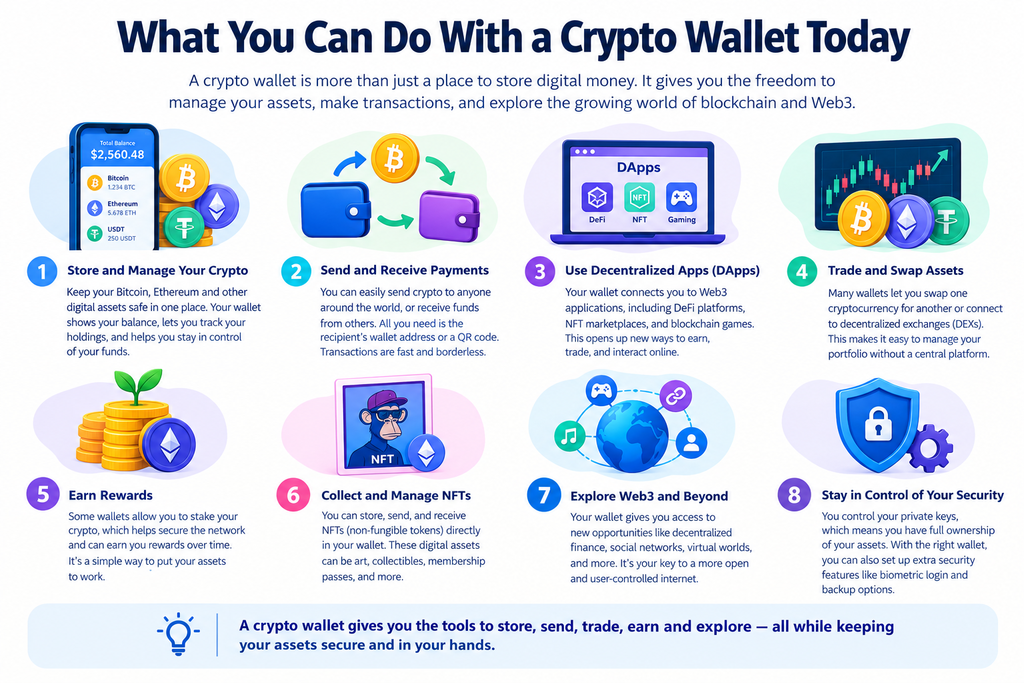
Saving and sending coins is just the beginning. Modern wallets have grown into small financial hubs, and knowing what they can do helps you pick one that matches your goals.
Most wallets let you swap one coin for another without leaving the app. Instead of going to an exchange, you choose the two coins, see the price, and confirm. Many also let you buy crypto with a bank card or a payment app, though the options depend on where you live. Some wallets are now adding ways to earn, such as staking, where you lock up certain coins to help run a network and receive rewards in return. Rewards are never guaranteed, and the rates change, so treat any promised percentage with care.
Wallets are also your key to the wider blockchain world. When you connect your wallet to a decentralized app, often called a dapp, you can lend, borrow, trade, play games, or collect NFTs without making an account. You simply approve each action from your wallet. Newer features include tokenized stocks and other real-world assets, prediction markets, and even payment cards that let you spend crypto in shops. These tools are growing quickly, but they are also newer and riskier, so it makes sense to learn slowly and start small.
How to Choose the Right Crypto Wallet
With so many options, the best way to choose is to think about what you really need. Start with security. A good wallet should be open about how it protects you, should have a long track record, and should let you control your own keys. Read reviews on the official app stores, and look for wallets that have been around for years rather than something that appeared last month.
Next, check which coins and networks it supports. If you only plan to hold Bitcoin, almost any wallet will do. If you want to hold coins on several blockchains, make sure the wallet covers all of them. It is annoying to find out later that your favorite coin is not supported.
Then think about ease of use. A wallet you cannot understand is a wallet you will use badly. Look for a clean design, clear instructions, and helpful support. Fees matter too, so check what the wallet charges for swaps and how it shows network costs before you confirm.
Finally, think about how much you are storing and how you plan to use it. If you trade often or explore new apps, a mobile or browser wallet makes sense. If you plan to hold for years, add a hardware wallet to your setup. There is no single best crypto wallet for everyone. The best one is the one that fits your habits and that you can use with confidence.
How to Set Up Your First Crypto Wallet
Getting started is easier than most people expect. Begin by downloading your chosen wallet from its official website or from the real app store listing. This step is important, because fake apps with similar names exist, and downloading the wrong one is one of the easiest ways to lose money. Check the developer name, the number of downloads, and the reviews before you install.
Once the app is open, you will be asked to create a new wallet. The app will then show you your recovery phrase. Take your time here. Write the words down by hand, in the right order, on paper, and check them twice. Store the paper somewhere safe and private, like a locked drawer or a home safe. Many people make two copies and keep them in different places, in case of fire or flood.
Avoid taking a screenshot, saving the words in your notes app, or emailing them to yourself. Anything stored online or on a device that connects to the internet can be stolen. After that, set a strong passcode or use your fingerprint or face to lock the app.
Before you add real money, send a very small test amount first. This lets you confirm that the address is right and that everything works the way you expect. Once you are comfortable, you can add more. If you ever want to be extra sure your backup works, you can practice restoring it on a spare device while your balance is still small.
Common Mistakes and Scams to Avoid
Most crypto losses do not come from clever hackers breaking into the blockchain. They come from people being tricked into handing over access. Knowing the common tricks goes a long way.
The most common trap is the fake support agent. Someone messages you on social media or a chat app, says they are from your wallet company, and offers to fix a problem. They then ask for your recovery phrase. Real wallet teams will never ask for it, ever. The moment anyone asks for those words, it is a scam.
Phishing is another big one. You may get an email, text, or ad that sends you to a website that looks almost identical to a real one. If you connect your wallet or type your phrase there, the scammers can drain your funds. Always type the web address yourself or use a saved bookmark, and be careful with links in ads and direct messages.
Be careful with random tokens that appear in your wallet, with offers that promise free money, and with any deal that guarantees profit. Approving a bad request from a shady website can give it permission to take your coins later, so read what you are approving. Rug pulls are also common with new tokens, where the creators take the money and disappear. If something sounds too good to be true, it almost always is.
Another simple mistake is sending coins to the wrong address or on the wrong network. Blockchain transactions cannot be undone, so double-check the address and the network every time, especially for larger amounts.
Simple Habits That Keep Your Wallet Safe
Good security does not need to be complicated. It comes down to a handful of habits that you repeat until they feel normal. Keep your recovery phrase offline and private. Keep your phone and apps updated, because updates often fix security holes. Use a strong, unique passcode, and turn on any extra protection your wallet offers.
Be slow when something feels urgent. Scammers love to rush you with fear or excitement. Take a breath, check the details, and ask yourself whether the request makes sense. It is also wise to avoid doing important transactions on public Wi-Fi, and to be careful about installing unknown apps on the device that holds your wallet.
Finally, do not put all your eggs in one basket. Spread your coins across a small everyday wallet and a safer long-term one, and never keep more in a hot wallet than you could stand to lose. If you build the habit of checking twice before you click, you already avoid most of the risks.
Read: Nothing Beats New York
Frequently Asked Questions About Crypto Wallets
Is a crypto wallet free?
Most software wallets are free to download and use. You only pay network fees when you send coins or make swaps, and sometimes small service fees for features like buying with a card. Hardware wallets cost money upfront because you are buying a physical device.
What happens if I lose my phone?
If you saved your recovery phrase, nothing is lost. You can install the wallet on a new phone, enter your words, and your coins will appear again, since they never lived on the phone in the first place. If you did not save the phrase, there is no way to recover the wallet.
Can I use more than one crypto wallet?
Yes, and many people do. You might use one for daily activity and another for long-term savings, or separate wallets for different goals. Just make sure each one has its own safely stored backup.
Do I need a wallet if I use an exchange?
Not to get started, since exchanges hold coins for you. But if you plan to keep crypto for a long time, or use blockchain apps, a personal wallet gives you more control and more choices.
Final Thoughts
A crypto wallet is your doorway into the world of digital money. Once you understand the basics, it stops feeling scary. It is just a tool that proves what is yours and lets you move it when you want. The key points are easy to remember: protect your recovery phrase like it is cash, choose a wallet from a trusted source, match the wallet type to how you plan to use it, and take your time before approving anything.
Start small, learn as you go, and add more advanced tools only when you feel ready. With a little care, a crypto wallet can be a simple, safe, and even enjoyable way to take real control of your money. This article is for general education only and is not financial advice, so always do your own research before you invest.
1 thought on “Crypto Wallet: What It Is, How It Works, and How to Choose the Right One”